
You will learn about how to calculate courses and distances by plane sailings, parallel sailings, Mercator sailings, great circle sailings and composite great circle sailing.
Each calculation features a “how to” guide and a worked example video for each question type.
You will also learn about the magnetic and gyro compass.
This online training for Deck Cadets is aligned with the Standards of Training, Certification and Watchkeeping (STCW) and the UK MCA / Scottish Qualifications Authority (SQA) Level 7 Navigational Maths and Science unit.
This learning can be used to study and prepare for:
- Navigational Maths and Science assessment
- SQA Navigation assessment
- UK MCA Orals assessment.
You can see the contents of what is contained in this unit in the contents list below, and subscribe here.
- Calculating Courses and Distances
- Difference of Latitude (D’Lat)
- Mean Latitude
- D’Long
- Departure
- Plane Sailings
- Traverse Sailing
- Parallel Sailings
- Mercator Sailing
- How to Complete a Mercator Sailing – Finding Course and Distance
- How to Complete a Mercator Sailing – Finding a Final Position
- Great Circle Sailings
- How to Complete a Great Circle Sailing
- Napier’s Rules
- How to Complete a Great Circle Sailing using Napier’s Wheel
- Finding the Vertex
- Composite Great Circles
- How to Complete a Composite Great Circle
- Magnetic Compass
- The Earth’s Magnetic Field
- The Three Components of the Earth’s Magnetic Field
- Variation and the Magnetic Compass
- Permanent and Induced Magnetic Fields
- The Compass Binnacle
- Maintaining the Magnetic Compass
- Gyro Compass
- The Properties of the Free Gyroscope
- The Operation of the Marine Gyrocompass
- Errors on a Gyroscope
Calculating Courses and Distances
Difference of Latitude (D’Lat)
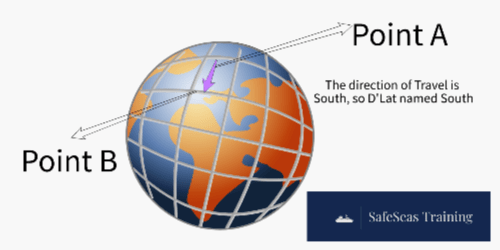
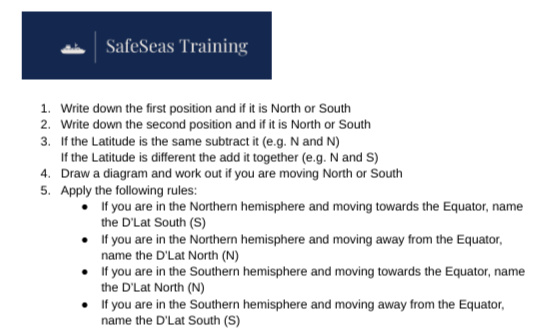
As you move from one latitude to another, you will change latitudes. This is known as the difference in Latitude, or D’Lat.
D’Lat can be ‘N’ if you are moving in a Northerly direction but does not necessarily mean you are in the Northern Hemisphere. You name D’Lat in the direction you are moving.
Mean Latitude
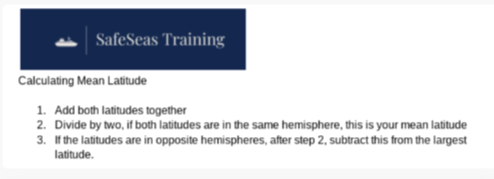
Finding the mean latitude is not quite as simple as adding both latitudes and dividing by two, it depends on which hemisphere you are in.
Subscribe to get access
Read more of this content when you subscribe today.
 SafeSeas Training