
You will learn how to safely navigate a ship as a Deck Officer. You will learn about the International Regulations for the Prevention of Collisions at Sea (COLREGS), Region A and B buoyage, when to call the Master and checks you need to conduct to Bridge Equipment.
This online training for Deck Cadets is aligned with the Standards of Training, Certification and Watchkeeping (STCW) and the UK MCA / Scottish Qualifications Authority (SQA) Level 7 Bridge Watchkeeping unit.
This learning can be used to study and prepare for:
- Bridge Watchkeeping assessment
- UK MCA Orals assessment
- Crew Evaluation System (Navigation) questions
- Interview preparation.
You can see the contents of this unit below and subscribe here.
- When should the Officer of the Watch call the Master?
- Power Driven Vessels Lights
- Power Driven Vessels Sound Signals
- Vessels Not Under Command Lights
- Vessels not under command Sound Signals
- Vessels Engaged in Fishing Lights
- Vessels engaged in fishing Sound Signals
- Vessels Engaged in Trawling Lights
- Vessels engaged in trawling Sound Signals
- Sailing Vessels Lights
- Sailing Vessel Sound Signals
- Pilot Vessel Lights
- Pilot Vessel Sound Signals
- Vessels Restricted in their Ability to Manoeuvre Lights
- Vessel Restricted in Ability to Manoeuvre Sound Signals
- Vessels Constrained by Draught Lights
- Vessels constrained by draught Sound Signals
- Vessels at Anchor Lights
- Vessels at anchor Sound Signals
- Vessels Aground Lights
- Vessels Aground Sound Signals
- Vessels Towing & Pushing Lights
- Vessels Towing & Pushing Sound Signals
- Lights and shapes regulations quiz
- Lights practice PDF
- Steering and Sailing Rules
- Lookout
- Safe Speed
- Risk of Collision
- Action to Avoid Collision
- Narrow Channels
- Traffic Separation Schemes
- Sailing Vessels
- Overtaking Vessel
- Head On Situation
- Crossing Situation
- Action by a Give Way Vessel
- Actions by a Stand On Vessel
- Responsibilities Between Vessels
- COLREGs definitions Quiz
- COLREGs situations Quiz
- Conduct of Vessels in Restricted Visibility
- Rule 19 actions with multiple vessels checklist
- Rule 19 quiz
- Buoyage
- IALA Maritime Buoyage Systems PDF download
- Cardinal Buoys
- North Cardinal
- East Cardinal Mark
- South Cardinal Mark
- West Cardinal Mark
- How to Pass a Cardinal Mark
- IALA Region A Lateral Buoys
- Port Hand Lateral Marks
- Starboard Hand Lateral Marks
- Preferred Channel Marks
- Preferred Channel to Port
- Preferred Channel to Starboard
- Safe Water Mark
- Isolated Danger Mark
- How to Pass an Isolated Danger Mark
- Emergency Wreck Marking Buoy
- Special Marks
- Region A all buoys by day and night
- Region B all buoys by day and night
- Buoyage Quiz
- Checks to Navigation Equipment
- Communications between the Bridge and the Engine Room
- Manoeuvring Characteristics and Stopping Distances
- Radar plotting
- Navigating in Ice
When should the Officer of the Watch call the Master?
The Officer of the Watch should call the Master:
- When restricted visibility is expected or encountered
- When the officer of the watch is concerned about the traffic density, movements or condition of traffic
- On receiving a distress alert or sighting a distress signal
- When the position of last observed position and expected position vary greatly
- If the ship cannot maintain course
- When land, a navigation mark or soundings are not identified / sighted at the expected time
- Encountering land or a navigation mark when it is not expected
- If amendments to the passage plan require immediate approval
- Loss of engines, propulsion control, steering gear or any essential navigational equipment
- A malfunction of the GMDSS equipment
- If there is concern the vessel may become damaged in heavy weather
- On encountering a hazard to navigation, such as ice
- If there are concerns around the ship’s security and
- If the OOW is unsure of any situation and requires the support of the Master.
Power Driven Vessels Lights
(a) A power-driven vessel underway shall exhibit:
(i) a masthead light forward;
(ii) a second masthead light abaft of and higher than the forward one; except that a vessel of less than 50 meters in length shall not be obliged to exhibit such light but may do so;

(iii) sidelights;
(iv) a sternlight.
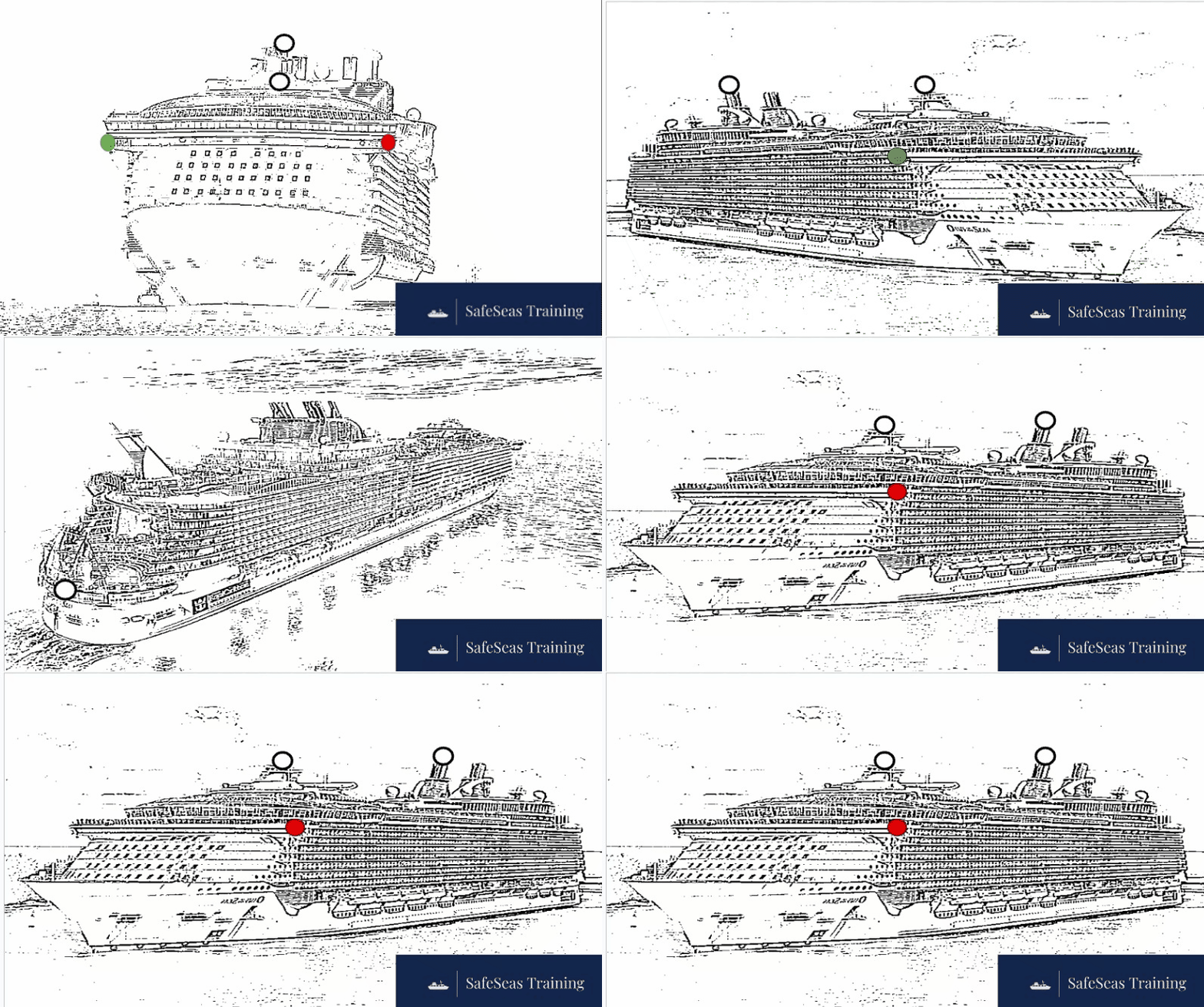
(b) An air-cushion vessel when operating in the non-displacement mode shall, in addition to the lights prescribed in paragraph (a) of this Rule exhibit an all-round flashing yellow light.
(c) A WIG craft only when taking off, landing and in flight near the surface shall, in addition to the lights prescribed in paragraph (a) of this Rule, exhibit a high intensity all-round flashing red light.
(d) (i) A power-driven vessel of less than 12 meters in length may in lieu of the lights prescribed in paragraph (a) of this Rule exhibit an all-round white light and sidelights:
(ii) a power-driven vessel of less than 7 meters in length whose maximum speed does not exceed 7 knots may in lieu of the lights prescribed in paragraph (a) of this Rule exhibit an all-round white light and shall, if practicable, also exhibit sidelights;
(iii) the masthead light or all-round white light on a power-driven vessel of less than 12 meters in length may be displaced from the fore and aft centreline of the vessel if centreline fitting is not practicable, provided that the sidelights are combined in one lantern which shall be carried on the fore and aft centreline of the vessel or located as nearly as practicable in the same fore and aft line as the masthead light or the all-round white light.
Power Driven Vessels Sound Signals
In or near an area of restricted visibility, whether by day or night, the signals prescribed in this Rule shall be used as follows:
(a) A power-driven vessel making way through the water shall sound at intervals of not more than 2 minutes one prolonged blast.
(b) A power-driven vessel underway but stopped and making no way through the water shall sound at intervals of not more than 2 minutes two prolonged blasts in succession with an interval of about 2 seconds between them.
Subscribe to get access
Read more of this content when you subscribe today.
 SafeSeas Training